
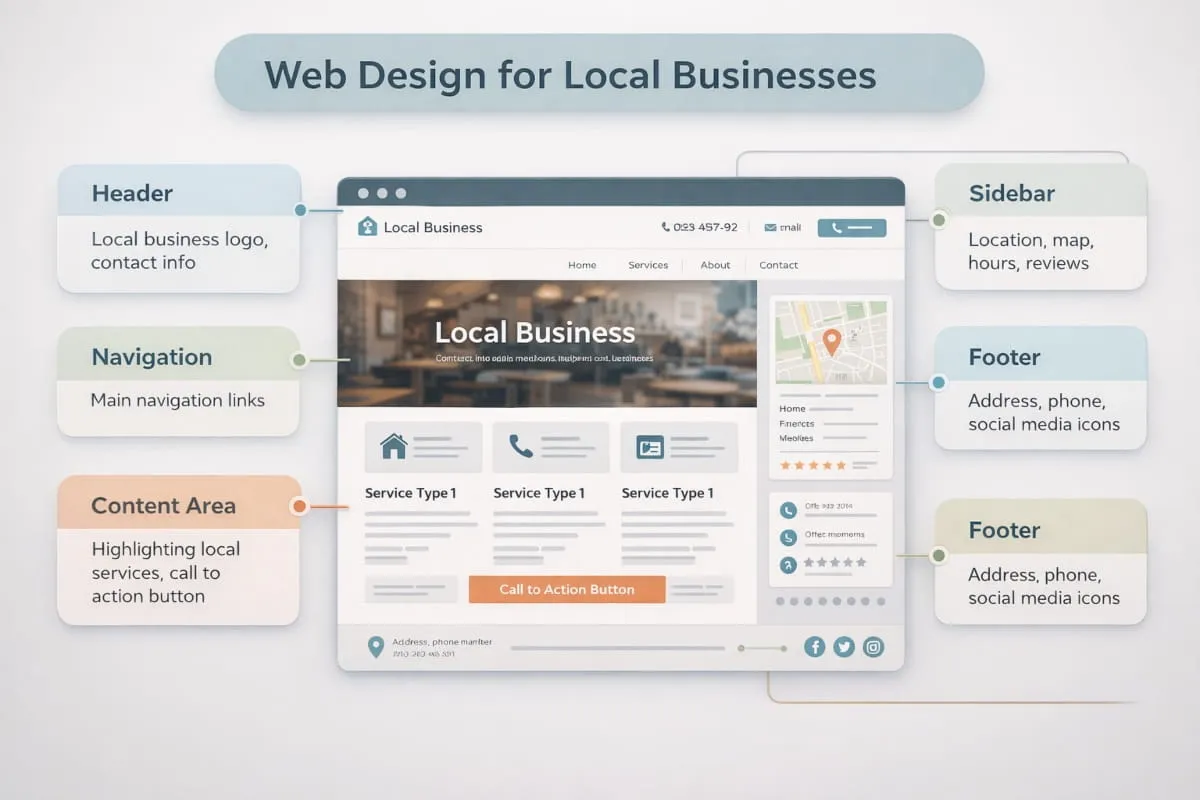
For local businesses, a website is no longer just an online brochure; it is often the first place customers decide whether to call, visit, or move on to a competitor. Effective web design for local businesses goes beyond visual appeal. It combines clear messaging, local search visibility, mobile usability, and conversion-focused design to turn nearby searchers into real customers.
This guide is built to help you understand exactly what high-performing local business web design includes, why it directly impacts calls and foot traffic, and what elements matter most today, from SEO-friendly structure to mobile-first layouts and trust-building content. Whether you’re planning a new website or evaluating an existing one, this resource walks you through how a well-designed site supports local growth, improves visibility in search results, and makes it easy for customers to take action.
By the end, you’ll have a clear, decision-ready understanding of how strategic web design helps local businesses attract the right audience, earn trust quickly, and convert online attention into real-world sales, without relying on guesswork or outdated design trends.
What Local Business Web Design Means (and Why It’s Different)
Local business web design is the practice of creating websites specifically built to attract, inform, and convert customers within a defined service area. Unlike generic websites that aim for broad visibility, web design for local businesses focuses on local search intent, people actively looking for nearby services, directions, phone numbers, and immediate solutions. The goal is not just to look good, but to make it effortless for local customers to find you, trust you, and take action.
At its core, web design local business strategy blends structure, content, and technical setup to support local SEO, mobile usage, and conversion behavior. Every design choice, from page layout to calls-to-action, is made with the local customer journey in mind.
Local intent vs general websites
General websites are often designed for wide audiences, long browsing sessions, or purely informational purposes. Local business websites, however, serve a very different intent. Visitors usually arrive with urgency: they want a service, a location, or a way to contact you quickly. This is why custom web design for local businesses prioritizes clarity over complexity, speed over decoration, and action over exploration.
Instead of multiple abstract pages, local-focused sites emphasize clear service offerings, visible contact details, location signals, and mobile-friendly layouts. The design supports quick decision-making, helping visitors move from search to call, visit, or booking with minimal friction.
What Google expects from local business sites (trust, relevance, usefulness)
Google evaluates local business websites differently from general-purpose sites. For strong local rankings, your website must clearly demonstrate trust, relevance, and usefulness. Trust comes from consistent business information, real-world signals (such as reviews and credentials), and a professional presentation. Relevance is established through clearly defined services, geographic context, and content that matches local search intent. Usefulness is shown by how easily users can find answers, contact you, or complete an action.
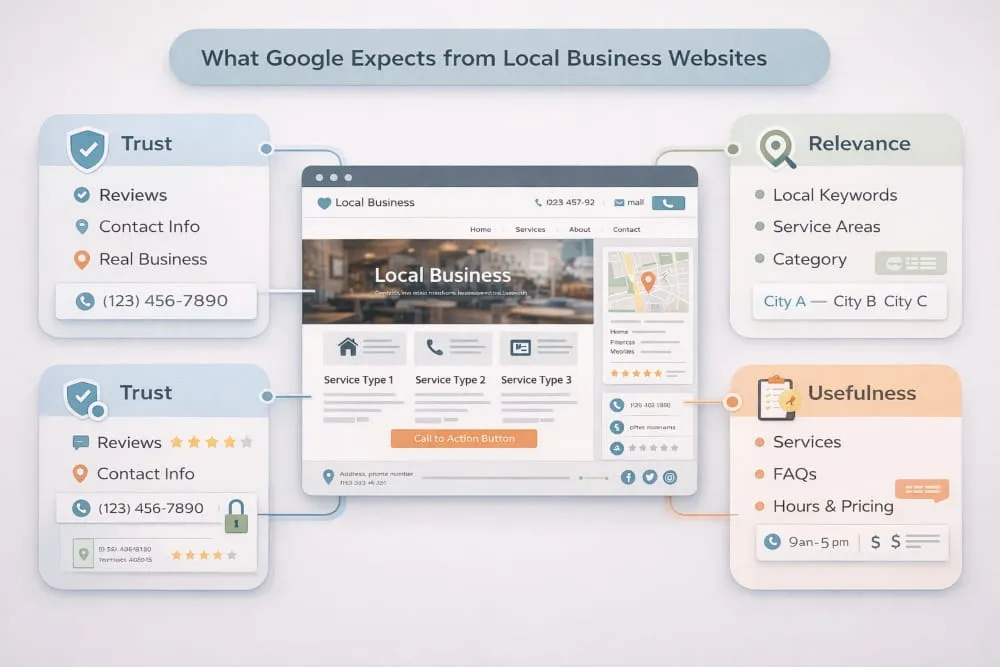
This is where custom web design for local businesses plays a critical role. A well-structured site helps search engines understand who you serve and what you offer, while also delivering a smooth, intuitive experience for real users. When design, content, and local intent work together, your website becomes a reliable bridge between online visibility and offline business growth.
Why Web Design Drives Local Growth
For local companies, a website is often the moment where interest turns into action. Local business growth through web design happens when a site is built with clear intent: guiding visitors toward calling, booking, or visiting, without confusion or friction. Design choices directly influence how easily customers move from “just looking” to becoming paying clients.
A well-structured website aligns layout, content, and functionality with how local customers actually behave online. Instead of overwhelming visitors with unnecessary pages or visuals, effective local-focused design highlights the information people want most and places it exactly where they expect it.
Turning traffic into phone calls, bookings, and directions
Local search traffic is highly valuable because it often comes with immediate intent. People searching for nearby services usually want fast answers and clear next steps. Web design supports this by making phone numbers visible, simplifying booking forms, and integrating map directions seamlessly into the page.
When calls-to-action are placed strategically, and the site is optimized for mobile use, visitors don’t have to think about what to do next. They act. This is how design turns passive traffic into measurable outcomes: more calls, more appointments, and more foot traffic.
Trust signals that increase conversions (reviews, guarantees, proof, photos)
Trust is a deciding factor for local customers, especially when choosing between similar businesses. Strong web design makes trust signals easy to see and easy to believe. Reviews, certifications, guarantees, and real photos of your team or location reassure visitors that your business is legitimate and reliable.
By presenting these elements clearly and professionally, your website reduces hesitation and builds confidence quickly. This credibility is essential to local business growth through web design, as customers are far more likely to convert when they feel secure in their choice. When trust and usability work together, your website becomes a growth asset, not just an online presence.
The Must-Have Features of High-Performing Local Business Websites
High-performing local business websites are built with a clear purpose: help nearby customers quickly understand what you offer, trust your business, and take action. Design alone isn’t enough. The strongest results come from combining structure, usability, performance, and search visibility into one cohesive experience.
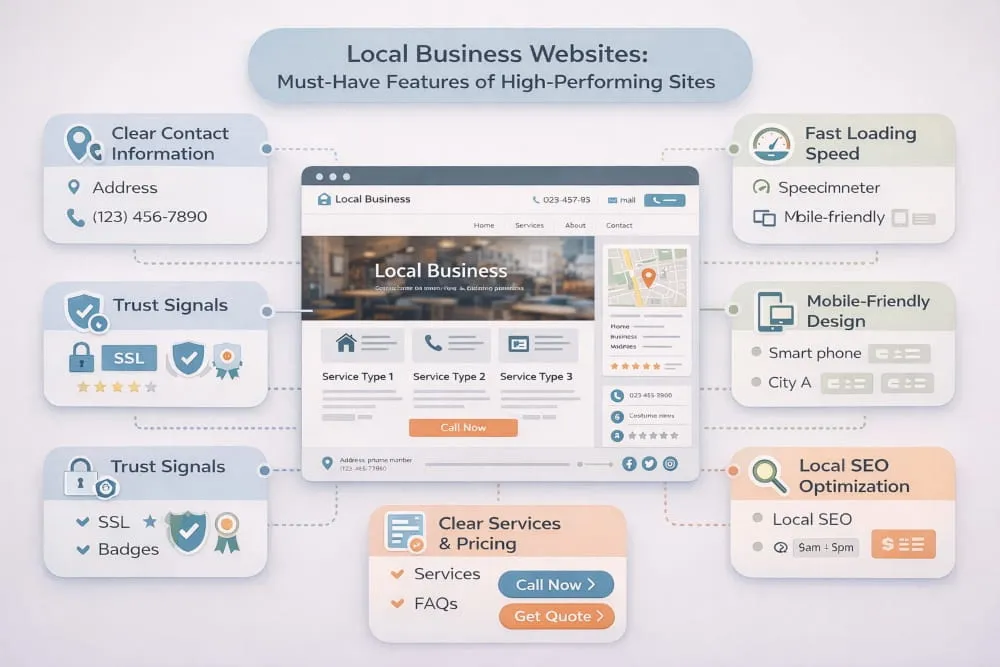
Below are the essential features that consistently support visibility, engagement, and conversions for local businesses.
Clear service pages + location targeting (without keyword stuffing)
Every local business website should clearly explain its services and the areas it serves. Dedicated service pages help both users and search engines understand exactly what you offer, while subtle location context reinforces relevance for local searches.
The key is clarity, not repetition. Natural references to your service area, service descriptions written for real people, and logically organized pages perform far better than forced keywords. When content is helpful and specific, it supports rankings without harming user experience.
Click-to-call, booking, quote forms, and lead capture
Local customers often want fast contact. High-performing websites make this easy by placing phone numbers, booking options, and quote forms where users can access them instantly, especially on mobile devices.
Click-to-call buttons, simple booking flows, and short lead forms reduce friction and encourage action. When these elements are clearly visible and easy to use, visitors are far more likely to convert instead of leaving to contact a competitor.
Fast load speed, Core Web Vitals basics, and accessibility essentials
Speed and usability directly impact both rankings and user behavior. Pages that load slowly or feel difficult to use create frustration and reduce trust. Optimizing for fast load times, stable layouts, and responsive interaction helps meet Core Web Vitals standards and keeps visitors engaged.
Accessibility is equally important. Readable text, clear contrast, logical navigation, and keyboard-friendly design ensure your website is usable for a wider audience while also supporting search engine evaluation and long-term performance.
Schema for local businesses (LocalBusiness, Service, FAQ)
Structured data helps search engines understand your business more clearly. LocalBusiness, Service, and FAQ schema provide context about what you do, where you operate, and how users can interact with you.
When implemented correctly, schema can improve visibility in search results, support rich snippets, and reinforce trust signals. While users may not see schema directly, it strengthens how your website communicates with search engines, supporting stronger local presence and discoverability.
SEO-Optimized Web Design for Local Businesses
Effective SEO-optimized web design for local businesses starts with understanding that design and search visibility are not separate efforts. A high-performing local website is structured, written, and built in a way that helps search engines clearly understand your services while guiding users smoothly toward action. When SEO and design work together, your site becomes easier to find, easier to use, and more likely to convert.
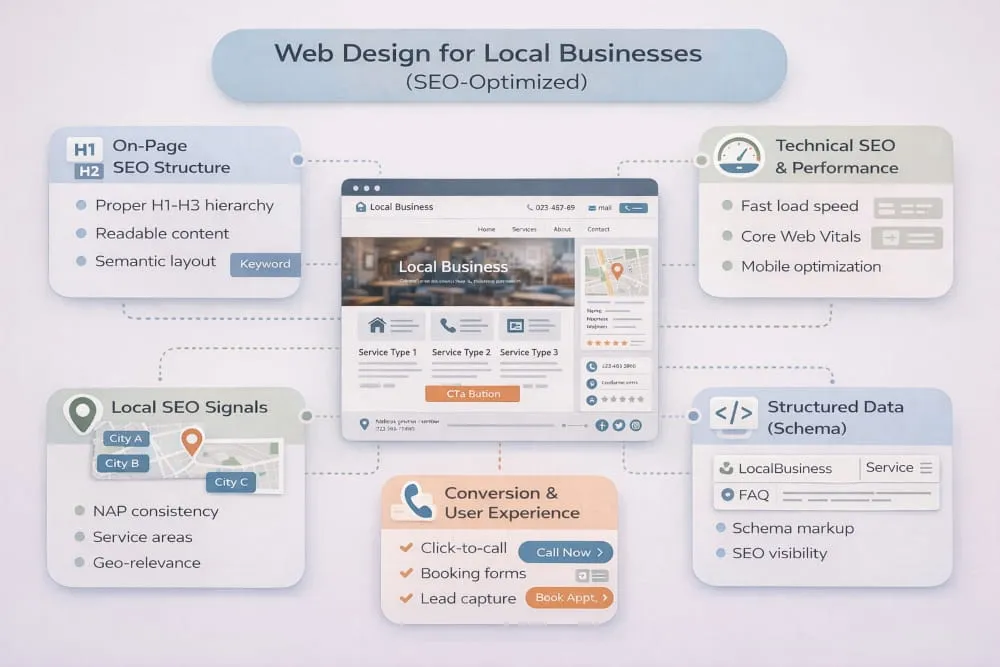
Modern web design and development services for local businesses increasingly follow a mobile-first approach, ensuring performance, usability, and visibility are aligned from the ground up.
Site architecture that ranks (homepage, services, areas served, FAQs)
A strong site structure helps search engines and users navigate your content effortlessly. For local businesses, this typically means a focused homepage, clear service pages, an areas-served section, and a well-organized FAQ page.
This structure supports both discoverability and usability. Search engines can easily map your services to local intent, while users can quickly find the information they need. Custom web design and development for local businesses often prioritizes this simplicity, avoiding unnecessary pages that dilute relevance or confuse visitors.
On-page SEO checklist (titles, headings, internal links, media)
On-page optimization ensures every page communicates its purpose clearly. Descriptive titles, properly structured headings, logical internal linking, and optimized images all help reinforce topical relevance without over-optimization.
Clean design supports these efforts by improving readability and navigation. When web design and content are aligned, pages feel natural to users while remaining search-engine friendly, an essential balance for sustainable local rankings.
Local signals: NAP consistency, Google Business Profile alignment
Search engines rely heavily on local signals to confirm business legitimacy. Consistent name, address, and phone number (NAP) information across your website and online listings strengthens trust and visibility. Aligning your website content with your Google Business Profile further reinforces local relevance.
Well-executed web design and digital marketing for local businesses ensure these signals are easy to find, clearly presented, and technically consistent, supporting both user confidence and search engine validation.
Content that ranks locally (service intent + problem/solution pages)
Local content performs best when it matches real user intent. Pages that clearly explain services while addressing common customer problems tend to rank more reliably than generic blog posts. Problem-solution content demonstrates expertise and relevance, helping visitors feel understood and supported.
Combined with mobile-first web design trends for local businesses, this approach ensures content is readable, actionable, and accessible on any device. When content strategy and design are developed together, your website becomes a long-term asset for local visibility and growth.
Mobile-First Web Design Trends That Matter for Local Customers
For most local businesses, mobile devices are now the primary way customers discover services, compare options, and take action. Mobile-first web design is no longer a trend; it’s the baseline. Sites that are designed with mobile users in mind consistently perform better in search results and convert at higher rates because they align with how people actually search and browse locally.
High-performing local websites focus on usability, speed, and simplicity, ensuring that essential actions are easy to complete on small screens without frustration.
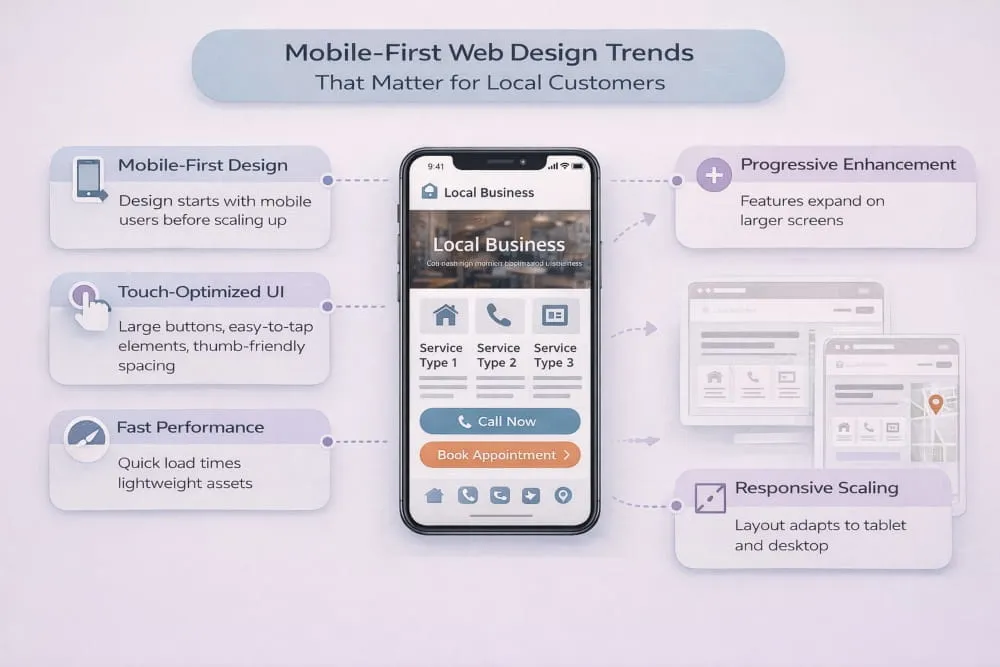
Thumb-friendly UI: buttons, menus, forms
Mobile users interact with websites using their thumbs, not cursors. Buttons that are too small, crowded menus, or long forms create friction and lead to abandoned visits. Thumb-friendly design places buttons within easy reach, simplifies navigation, and reduces the effort required to move through a page.
Clear spacing, readable text, and intuitive menus help visitors find what they need quickly. When navigation feels natural on mobile, users are more likely to stay engaged and move toward conversion.
Mobile conversions: sticky call bar, tap-to-map, short forms
Local customers often want immediate contact. Mobile-first design supports this by making calls, directions, and bookings accessible at all times. Sticky call bars keep contact options visible as users scroll, while tap-to-map features make it easy to get directions instantly.
Short, streamlined forms further reduce barriers to action. By asking only for essential information, businesses make it easier for users to request quotes, schedule appointments, or send inquiries directly from their phones.
What to avoid (popups, heavy sliders, slow themes)
Not all design elements translate well to mobile. Intrusive popups, large sliders, and heavy themes often slow down load times and interrupt the user experience. These elements can frustrate visitors and negatively impact search performance.
Mobile-first design prioritizes speed and clarity over visual excess. By avoiding unnecessary features and focusing on performance, local business websites create a smoother experience that keeps users engaged and encourages them to take the next step.
Web Design + Digital Marketing for Local Businesses (How They Connect)
Web design and digital marketing work best when they are planned together, not treated as separate efforts. For local businesses, your website is the central hub that supports every marketing channel, from search and social to paid ads and email campaigns. When design and marketing are aligned, traffic is not just driven to the site, but guided toward meaningful action.
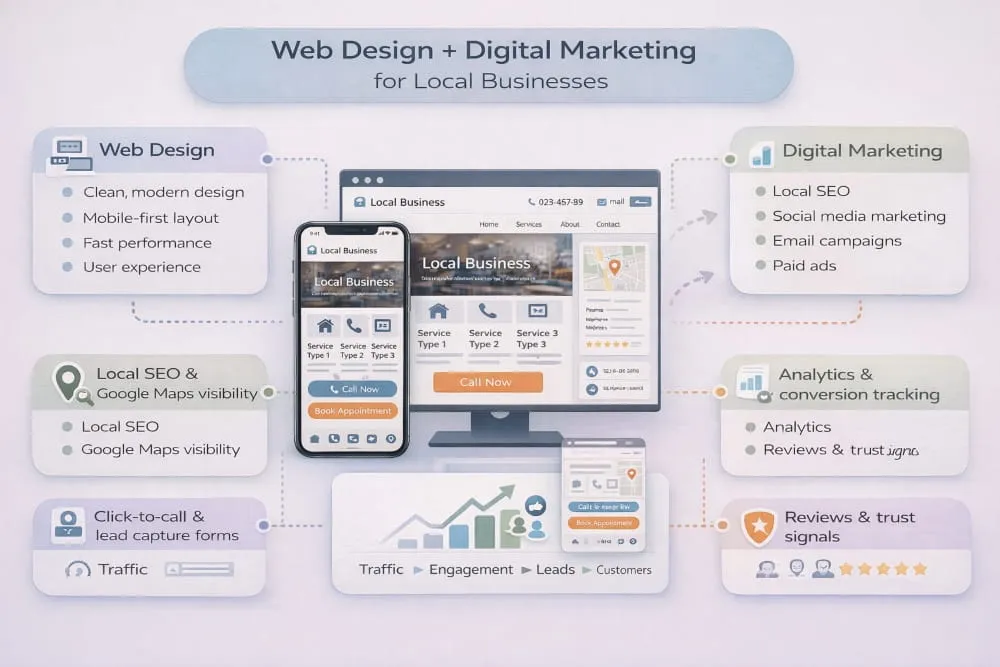
A well-designed website ensures that marketing efforts lead to consistent messaging, clear offers, and measurable results.
Landing pages for ads and promotions
Paid ads and promotions perform best when they lead to focused landing pages rather than generic homepages. These pages are designed with a single goal in mind, such as booking an appointment, claiming an offer, or requesting a quote.
Effective landing pages remove distractions, reinforce ad messaging, and highlight a clear call-to-action. For local businesses, this approach increases relevance, improves conversion rates, and ensures that ad spend results in real inquiries instead of wasted clicks.
Tracking basics: GA4 events, call tracking, form tracking
Design and marketing alignment also depends on accurate tracking. Modern websites should be set up to measure key actions such as phone calls, form submissions, and bookings. GA4 event tracking, combined with call and form tracking, helps businesses understand which channels are driving results.
When tracking is integrated into the website design, it becomes easier to identify what’s working and where improvements are needed. This data-driven insight supports smarter marketing decisions and more effective budget allocation.
Retargeting-ready pages and offer positioning
Not every visitor converts on the first visit. Retargeting-ready pages allow businesses to reconnect with potential customers through ads or follow-up campaigns. Clear offer positioning, consistent messaging, and structured page layouts make retargeting efforts more effective.
By designing pages with retargeting in mind, local businesses create a seamless path from initial visit to final conversion. This connection between web design and digital marketing strengthens long-term engagement and maximizes the value of every website visit.
The Local Business Website Build Process (Start to Launch)
A successful local business website is rarely the result of a single design step. It’s built through a structured process that aligns business goals, customer intent, and technical performance from the very beginning. Following a clear build process ensures the final site not only looks professional but also supports visibility, usability, and long-term growth.
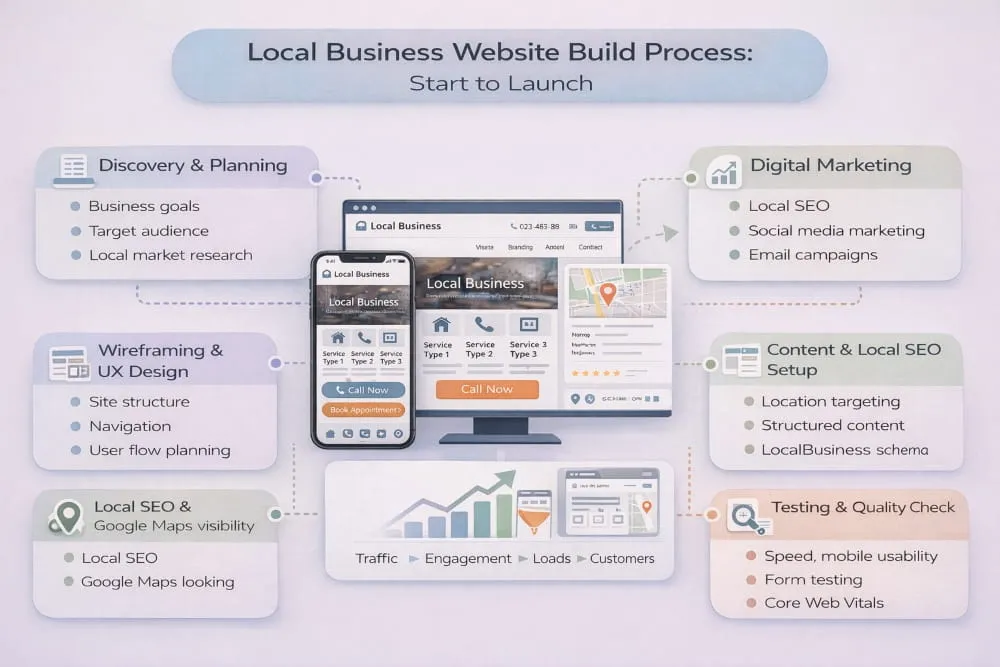
Below is a practical overview of how high-performing local business websites are planned and launched.
Discovery: goals, customer intent, competitors
The process begins with discovery. This stage focuses on understanding business objectives, the needs and behavior of local customers, and the competitive landscape. Defining goals early, such as increasing calls, bookings, or in-store visits, helps shape every design and content decision.
Analyzing customer intent reveals what visitors are searching for and how they expect to interact with the site. Reviewing competitors highlights opportunities to differentiate through clearer messaging, stronger usability, or better local relevance.
Messaging: value proposition, services, proof
Once the foundation is set, messaging takes priority. A strong value proposition explains why customers should choose your business, while clearly defined service descriptions remove confusion. Supporting proof, such as testimonials, certifications, and experience, reinforces credibility.
This stage ensures that content speaks directly to local customers and addresses their concerns in a clear, confident tone, setting the stage for trust and conversions.
Design: wireframes → UI → revisions
Design begins with wireframes that map out page structure and user flow. This allows functionality and usability to be refined before visual elements are introduced. From there, user interface (UI) design brings branding, colors, and typography into the layout.
Revisions are a natural part of this phase. Iterative feedback ensures the design remains aligned with goals, usability standards, and local audience expectations.
Development: performance, SEO, and integrations
Development turns design concepts into a working website. This phase focuses on clean code, fast load times, mobile responsiveness, and SEO-friendly structure. Integrations such as contact forms, booking tools, analytics, and maps are implemented to support functionality and tracking.
Prioritizing performance and SEO during development helps prevent technical issues that could limit visibility or user experience after launch.
Launch: redirects, indexing, QA checklist
The launch phase involves more than publishing the site. Proper redirects preserve existing search equity, indexing ensures search engines can discover new pages, and quality assurance checks confirm that everything works as intended.
Testing forms, links, mobile usability, and page speed helps catch issues before users encounter them. A structured launch process ensures the website starts strong and is positioned for long-term local success.
Cost, Timeline, and What Custom Web Design Usually Includes
Understanding the cost and scope of a local business website helps set realistic expectations and prevents costly mistakes. Custom web design is not a one-size-fits-all service. Pricing, timelines, and deliverables vary based on business goals, functionality, and long-term growth needs. Knowing what’s typically included and what to look out for makes it easier to evaluate options with confidence.
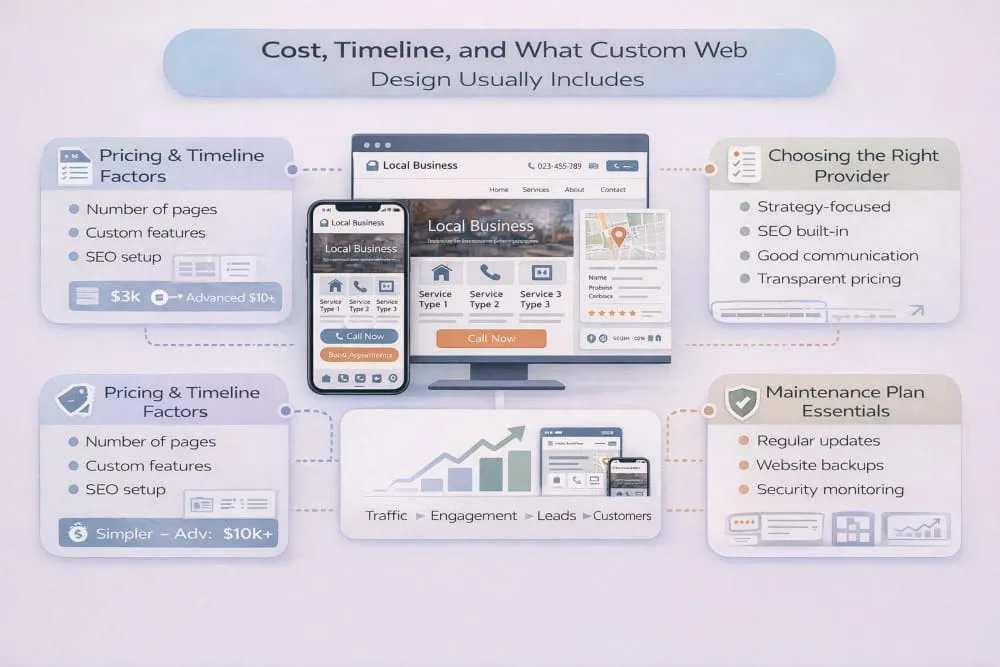
Pricing factors (pages, features, copywriting, SEO setup)
Website costs are influenced by several key factors. The number of pages, complexity of features, and level of customization all affect pricing. Sites that include booking systems, lead forms, or third-party integrations generally require more development time.
Copywriting and SEO setup are also important considerations. Professionally written content that aligns with local search intent adds value by improving clarity and visibility. SEO setup, including page structure and technical optimization, helps ensure the site is ready to perform from day one rather than requiring costly fixes later.
Red flags vs green flags when evaluating a provider
Choosing the right provider is just as important as the design itself. Red flags often include vague pricing, unclear deliverables, limited SEO considerations, or a lack of discussion about performance and mobile usability. Providers who focus only on visuals without addressing functionality or search visibility may leave you with a site that looks good but underperforms.
Green flags include transparent pricing, a clear process, attention to local search requirements, and a willingness to explain how design decisions support business goals. A strong provider treats your website as a growth tool, not just a design project.
Maintenance plan essentials (updates, backups, security)
A website requires ongoing care to remain secure and functional. Maintenance plans typically include software updates, regular backups, and basic security monitoring. These essentials help prevent downtime, data loss, and vulnerabilities that could affect user trust or search performance.
Consistent maintenance also supports long-term reliability and scalability. By keeping your website updated and protected, you ensure it continues to support your business well beyond the initial launch.
Blog Ideas for Local Businesses (That Actually Rank and Convert)
For local businesses, effective blogging is not about volume; it’s about relevance. Blog content should answer real customer questions, reinforce local expertise, and support conversions without feeling promotional. When aligned with local search intent, blog posts become long-term assets that attract qualified traffic and build trust over time.
Below are blog content types that consistently perform well for local businesses.
Service + question posts (problem → solution)
This format targets high-intent searches by combining a specific service with a common customer concern. The post begins by clearly explaining the problem, then walks through solutions while naturally positioning your service as the answer.
These posts work because they mirror how people search and think. By educating first and guiding second, they attract visitors who are already close to making a decision, making conversions more likely without aggressive selling.
Location + service angles (ethical, non-spammy)
Location-focused content supports local visibility when handled thoughtfully. Instead of duplicating the same article for multiple areas, strong local blogs provide context-specific insights, such as how a service applies locally, regional considerations, or common issues faced by nearby customers.
This approach maintains content quality while reinforcing geographic relevance. It signals authenticity to both users and search engines, helping your site rank locally without resorting to keyword-heavy tactics.
Seasonal + community content (events, guides, checklists)
Seasonal and community-driven content aligns your business with what’s happening locally throughout the year. Preparation guides, seasonal checklists, or posts tied to local events give customers timely, useful information when they need it most.
This type of content also strengthens local connection and brand familiarity. When paired with subtle calls-to-action, seasonal and community posts can drive both engagement and real-world business opportunities.
What Happens When Local SEO Is Ignored During Website Design
When local SEO is treated as an afterthought during website design, the impact is rarely immediate, but it is often costly over time. Many businesses launch visually appealing websites only to discover that they struggle to appear in local search results, attract qualified traffic, or generate consistent inquiries. This disconnect usually stems from design decisions made without considering how search engines and local users evaluate relevance.
Ignoring local SEO during the design phase often leads to structural issues that are difficult to fix later. Pages may lack a clear service focus, location context may be missing or unclear, and site architecture may not support how people search locally. As a result, search engines have trouble understanding who the business serves and what it should rank for, limiting visibility even when demand exists.
From a user perspective, the consequences are just as significant. Without SEO-informed design, key information such as services, service areas, or contact options may be buried or hard to find. Visitors who arrive through search may feel uncertain or frustrated, leading them to leave and choose a competitor with a clearer, more relevant website.
This is why integrating local SEO into website design from the start matters. When design and SEO work together, the site communicates trust, relevance, and usefulness, both to search engines and to real customers. Addressing local SEO early prevents wasted effort, shortens the path to visibility, and ensures that a website supports long-term local growth rather than quietly holding it back.
Website Redesign vs. New Build: Which Is Better for Local Rankings?
When a local business decides its website needs improvement, one key question often comes up: should the existing site be redesigned, or is it better to start with a completely new build? The answer isn’t universal. Both options can support strong local rankings when chosen for the right reasons, but each comes with different strategic implications.
A website redesign typically works well when the existing site already has some search visibility, indexed pages, and established local signals. Redesigning allows you to improve structure, usability, mobile performance, and on-page SEO while preserving existing rankings. This approach is often more efficient when the foundation is sound, but the design, content clarity, or conversion elements are outdated.
A new website build, on the other hand, may be the better choice when the current site has deeper issues. Poor architecture, unclear service focus, technical limitations, or a lack of local SEO signals can make redesigning inefficient. Starting fresh allows local SEO, mobile-first design, and conversion strategy to be built correctly from the ground up, without being constrained by legacy issues.
From a local rankings perspective, the deciding factor is alignment, not age. Search engines respond to clarity, relevance, and usability. Whether redesigning or rebuilding, success depends on preserving or improving service pages, maintaining consistent business information, and implementing proper redirects to protect visibility. Evaluating the current site honestly helps determine which path delivers stronger long-term results without unnecessary risk.
Conclusion
Effective web design for local businesses is not just about creating an attractive website; it’s about building a practical, growth-focused platform that helps nearby customers find you, trust you, and take action. When design, local SEO, mobile usability, and conversion strategy are aligned, a website becomes a powerful tool for generating calls, visits, and long-term business growth.
Throughout this guide, we’ve covered what sets local business web design apart, why it directly impacts visibility and conversions, and which features truly matter. From SEO-friendly structure and mobile-first design to trust signals and performance optimization, each element plays a role in helping your website compete in local search and meet real customer expectations.
The key takeaway is clarity. A high-performing local business website clearly communicates who you serve, what you offer, and how customers can reach you, without friction or confusion. By approaching web design as a strategic investment rather than a one-time task, local businesses can create websites that support sustainable growth, adapt to changing user behavior, and continue delivering value well beyond launch.
Frequently Asked Questions (FAQs)
What is web design for local businesses?
Web design for local businesses focuses on creating websites that attract, inform, and convert customers within a specific service area. Unlike general websites, local business web design emphasizes local search visibility, mobile usability, clear service messaging, and easy access to contact information. The goal is to turn nearby searchers into real calls, visits, and bookings by aligning design with local intent.
How do I know if my site is SEO-optimized for local search?
A site optimized for local search clearly communicates what services you offer and where you provide them. Signs of local SEO optimization include well-structured service pages, consistent business information, fast load speeds, mobile-friendly design, and content that matches local search intent. If your site is easy for both users and search engines to understand, it’s likely on the right track.
What’s the most important mobile-first improvement?
The most impactful mobile-first improvement is making it easy for users to take action quickly. This includes thumb-friendly navigation, visible click-to-call buttons, short forms, and fast-loading pages. Mobile users often have immediate intent, so reducing friction is key to higher conversions.
How often should a local business update its website?
Local business websites should be reviewed regularly and updated whenever services change, new information is added, or performance issues arise. Minor updates, such as content improvements or seasonal adjustments, can be made a few times a year, while technical maintenance and security updates should happen more frequently to keep the site reliable and secure.
How many pages does a local business website need?
There is no fixed number of pages, but most effective local business websites include a clear homepage, dedicated service pages, an about page, a contact page, and supporting content such as FAQs or blog posts. The focus should be on clarity and usefulness rather than page count, ensuring each page serves a clear purpose and supports local visibility.


