
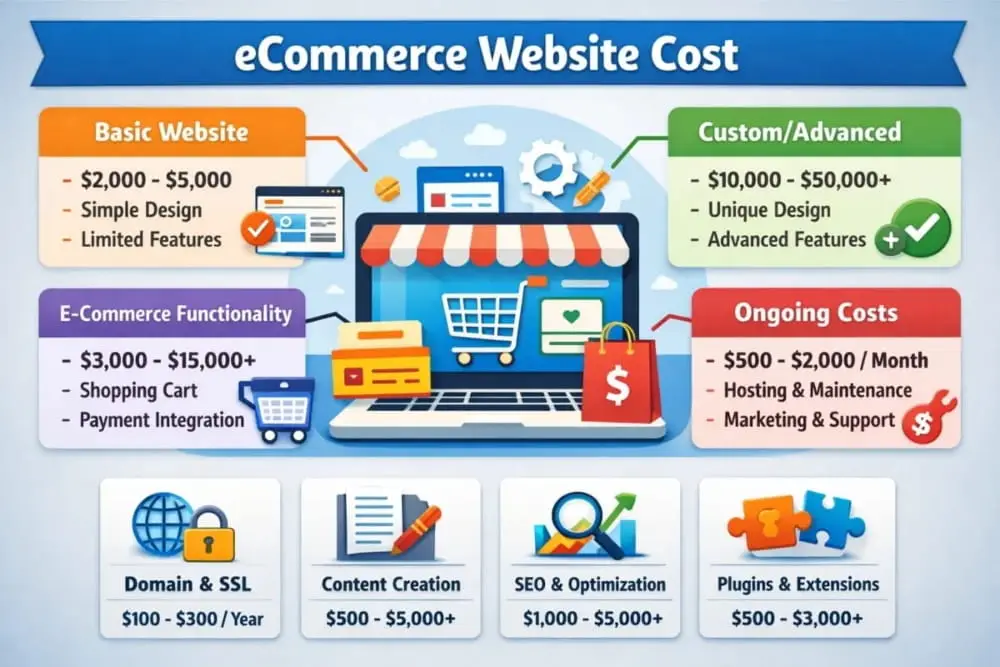
Building an online store is exciting, but before you dive into design, products, and marketing, one question comes up quickly: the cost of an e-commerce website. Whether you’re launching your first store or upgrading an existing one, understanding the real numbers upfront helps you plan smarter, avoid surprises, and invest where it matters most.
So, how much does an e-commerce website cost in 2026? The answer depends on what you need your store to do, how many products you’re selling, how complex your checkout and shipping rules are, and whether you’re going for a simple setup or a fully custom experience. That’s why you’ll see different price ranges when people ask what the cost of an e-commerce website development is, and why the cost of an e-commerce website can vary from one business to the next.
In this guide, we’ll break it all down clearly, so if you’re wondering how much an ecommerce website costs for a small business vs. a growing brand, you’ll get a straightforward answer with realistic expectations.
eCommerce Website Cost (2026)
In 2026, an e-commerce website typically costs $1,000–$5,000 for a basic store, $5,000–$20,000 for a professional small-to-mid business site, and $20,000–$100,000+ for a fully custom build with advanced features and integrations. So, how much does an e-commerce website cost? The final price depends on your store’s features, product volume, and scalability needs, meaning e-commerce website costs can vary widely based on what you’re building.
For most businesses, the average cost of an e-commerce website falls in the $5,000–$25,000 range, but how much an e-commerce website should cost depends on whether you need a simple setup or a custom experience. The more functionality you add, the higher the cost of the e-commerce website investment increases.
eCommerce Website Development Cost (What You’re Really Paying For)
When people talk about e-commerce website development cost, they’re not just referring to building a website. Development covers everything required to make your online store functional, secure, fast, and ready to sell, from setting up product pages and checkout to integrating payments, defining shipping rules, and managing the backend.
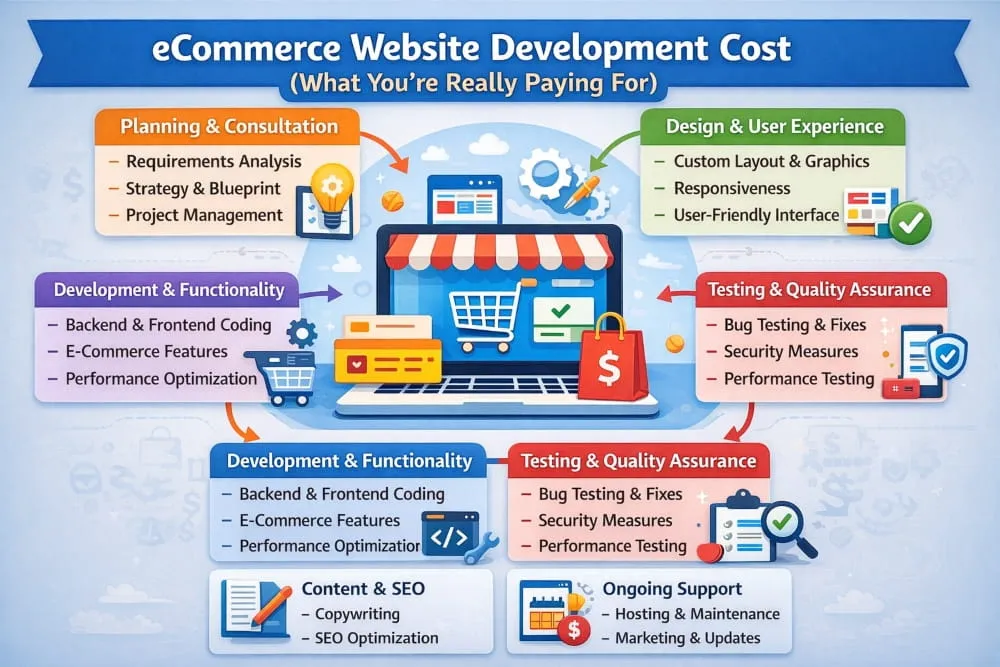
So, how much does it cost to build an e-commerce website? In most cases, the cost for e-commerce website development depends on the size of your store, the features you need, and whether you’re using a ready-made framework or building custom functionality. A simple store with standard features will naturally cost less, while a complex platform with automation, integrations, and advanced user experience will raise the overall budget.
Typical eCommerce Website Development Costs (By Complexity)
Here’s a realistic view of how e-commerce website development costs often break down:
- Basic store build: Best for startups with a small product catalog and standard checkout
- Mid-range business store: Ideal for growing brands that need better design, filters, and integrations
- Custom e-commerce build: Built for scale, performance, and unique functionality
That’s why the cost of developing an e-commerce website isn’t a one-size-fits-all number, and why two businesses can get completely different quotes for the same store idea.
eCommerce Website Development Cost Breakdown (Key Cost Drivers)
A proper e-commerce website development cost breakdown usually includes:
- Store architecture & setup (site structure, categories, product organization)
- Checkout and payment integration (secure payment gateways, cart flow)
- Shipping and tax configuration (zones, rules, dynamic pricing)
- Product and inventory system (management tools, variants, stock handling)
- Custom features (subscriptions, bundles, multi-currency, custom dashboards)
- Performance and security (speed optimization, SSL, secure coding practices)
The more advanced the requirements, the higher the cost of building an e-commerce website becomes, especially when custom workflows or third-party integrations are involved.
Cost to Build vs. Cost to Develop an eCommerce Website
Many people use these interchangeably, but there’s a slight difference in meaning:
- The cost to build an e-commerce website usually refers to creating the storefront and getting it live.
- The cost to develop an e-commerce website often includes deeper functionality, customization, and backend logic.
So if you’re asking how much it costs to develop an e-commerce website, the answer depends on whether you want a basic store launch or a platform designed to scale with your business.
Your e-commerce website build cost is ultimately determined by Complexity, not just the number of pages. The most innovative approach is to define what your store must do today and what it should handle in 6–12 months, then plan a build that supports growth without overspending upfront.
Average Cost of an eCommerce Website (Price Ranges)
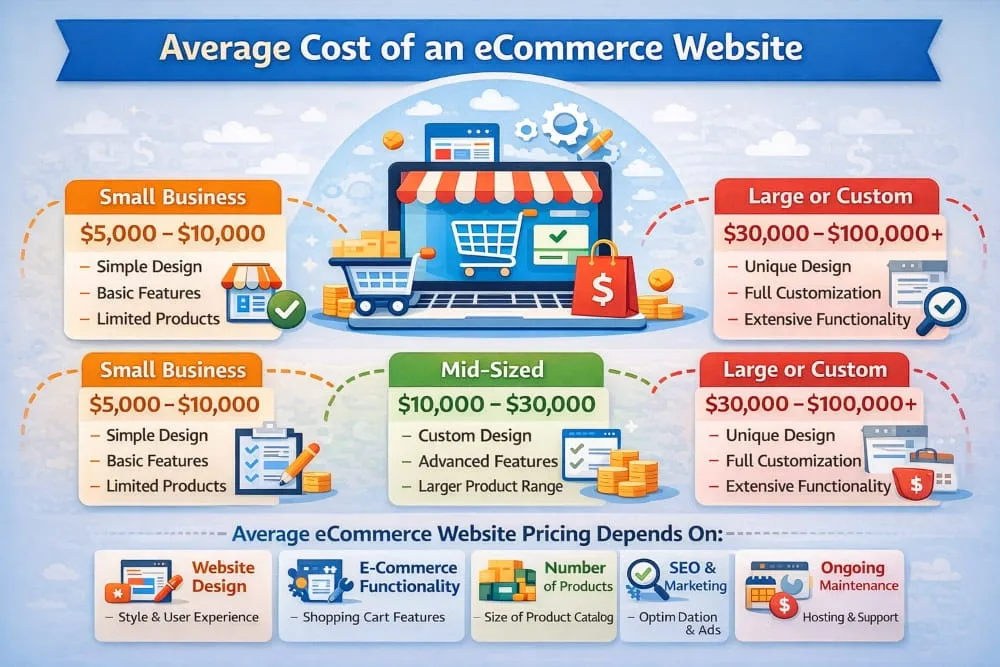
The average cost of e-commerce website development depends on what you’re building, how many products you sell, and how advanced your store needs to be. Some businesses only need a clean storefront with a simple checkout, while others require custom functionality, integrations, and a premium shopping experience. Below are realistic price ranges based on the most common e-commerce website types.
Basic eCommerce Website Cost
A basic e-commerce website cost is ideal for startups, solo sellers, and small catalogs that need a simple online store without heavy customization. This option focuses on getting you live quickly with essential selling features.
Best for: New businesses, small product ranges, MVP launches
Typically includes:
- A standard store layout and navigation
- Product pages with images, pricing, and descriptions
- Shopping cart + basic checkout setup
- Payment gateway integration
- Mobile-friendly design
- Basic security and launch support
This is the most cost-effective route when you need a functional store that looks professional, but doesn’t require advanced features right away.
Small Business eCommerce Website Cost
The cost of a small business ecommerce website usually falls in the mid-range because it includes a stronger design, a better user experience, and key integrations that help you sell more efficiently. It’s built for growth, not just launch.
Best for: Established small businesses, growing online brands
Typically includes:
- Custom-branded design (not just a template setup)
- Product filtering and improved category structure
- Better checkout flow and conversion-focused UX
- Shipping and tax configuration
- Integration with tools like email marketing, CRM, or inventory systems
- Basic SEO setup and performance improvements
This level is often where businesses get the best balance between affordability and long-term value.
Professional / Custom eCommerce Website Cost
A professional e-commerce website costs more because it’s built for performance, scalability, and a tailored customer experience. If you need advanced functionality, automation, or a unique storefront experience, you’re looking at the cost of a custom e-commerce website.
Best for: High-volume stores, competitive industries, scaling brands
Typically includes:
- Fully custom UX and UI design
- Advanced product logic (bundles, subscriptions, custom options)
- Custom checkout flows and optimized conversion journeys
- Multi-language or multi-currency support (if needed)
- Deep integrations (ERP, POS, warehouse, custom dashboards)
- Speed optimization, security hardening, scalability planning
This is the right choice when your store needs to operate like a platform, handling more traffic, more products, and more complex customer journeys without breaking under pressure.
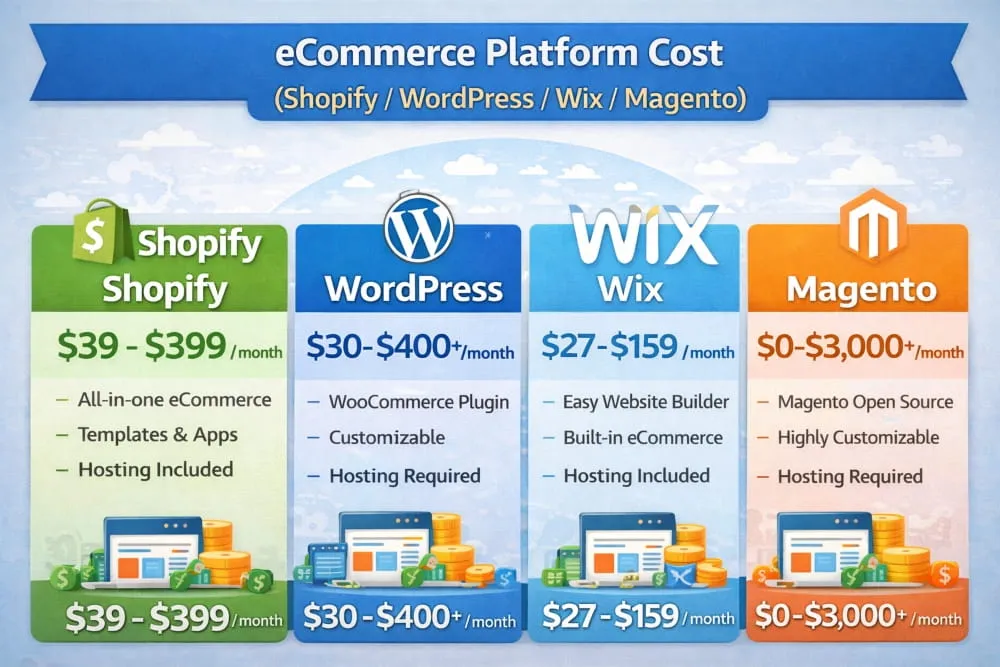
eCommerce Platform Cost (Shopify / WordPress / Wix / Magento)
Choosing the right platform plays a significant role in your total ecommerce budget. While the platform itself may look affordable at first, the real cost often comes from setup, customization, apps/plugins, and long-term scalability. Below is a clear breakdown of what to expect across the most popular options so that you can compare based on your business needs, not just monthly fees.
Shopify eCommerce Website Cost
The Shopify e-commerce website cost is popular because it’s fast to launch, beginner-friendly, and includes hosting and security out of the box. However, the total cost of a Shopify e-commerce website can increase depending on the level of customization you need and the number of apps you rely on.
Best for: Small to mid-sized businesses that want speed and simplicity
Cost drivers include:
- Monthly plan fees
- Paid themes and design customization
- Apps for advanced features (reviews, upsells, subscriptions, automation)
- Custom development for unique layouts or functionality
Shopify works best when you want a reliable store up and running quickly, without managing technical infrastructure.
WordPress / WooCommerce Website Cost
The cost of a WordPress e-commerce website can be flexible because the platform itself is free, but you’ll pay for hosting, themes, plugins, and development. The overall cost of the e-commerce WordPress website varies widely depending on how customized your store becomes.
Best for: Businesses that want flexibility and ownership
Cost drivers include:
- Hosting and security setup
- Premium themes and plugins
- Performance optimization (speed, caching, image handling)
- Custom features and integrations
If you need a more tailored solution, the cost of WordPress e-commerce website development typically increases. Still, you gain greater control over design and functionality than on many hosted platforms.
Wix eCommerce Website Cost
The Wix E-commerce website cost is often appealing to startups because it’s easy to build and manage without technical experience. It’s a good option for smaller stores, but it can become limiting if you need advanced e-commerce features.
Best for: Small catalogs and simple online stores
Cost drivers include:
- Monthly ecommerce plan
- Design limitations for complex UX
- Fewer advanced integrations compared to larger platforms
Wix is best when your priority is simplicity and speed, not heavy customization.
Magento eCommerce Website Cost
The cost of a Magento e-commerce website is typically higher because it’s built for complex stores and enterprise-level needs. The cost of Magento e-commerce website development depends heavily on custom functionality, hosting infrastructure, and long-term maintenance requirements.
Best for: Large stores, multi-location operations, enterprise ecommerce
Cost drivers include:
- Custom development and architecture
- Advanced product management requirements
- Hosting and server optimization
- Ongoing technical support and upgrades
Magento makes sense when you need scalability, deep customization, and a robust backend, especially for extensive catalogs or multi-store setups.
GoDaddy eCommerce Website Cost
The GoDaddy e-commerce website cost is usually positioned as a budget-friendly option for basic e-commerce. It can work for tiny stores, but may not offer the flexibility needed for growth-focused businesses.
Best for: Tiny businesses selling a limited number of products
Cost drivers include:
- Platform plan cost
- Limited customization and integrations
- Feature constraints as your store grows
This is a starter solution, but many businesses eventually upgrade when they need more control and advanced features.
Platform Choice Impacts Total Cost
Each platform has its own strengths, and the best one depends on your goals. If you want speed and stability, Shopify is a strong option. If you want flexibility and ownership, WordPress/WooCommerce is ideal. For enterprise-level needs, Magento is built to scale. For straightforward stores, Wix or GoDaddy may be enough to get started.
The key is to choose a platform that matches your growth plans, so you don’t end up rebuilding your store sooner than expected.
What Impacts the Total Cost of an eCommerce Website?
The total cost of an e-commerce website depends on how complex your store is to build, manage, and scale, because every feature you add increases the time, planning, and development required. Below are the key factors that influence pricing, explained in a clear, AI Overview-friendly way.
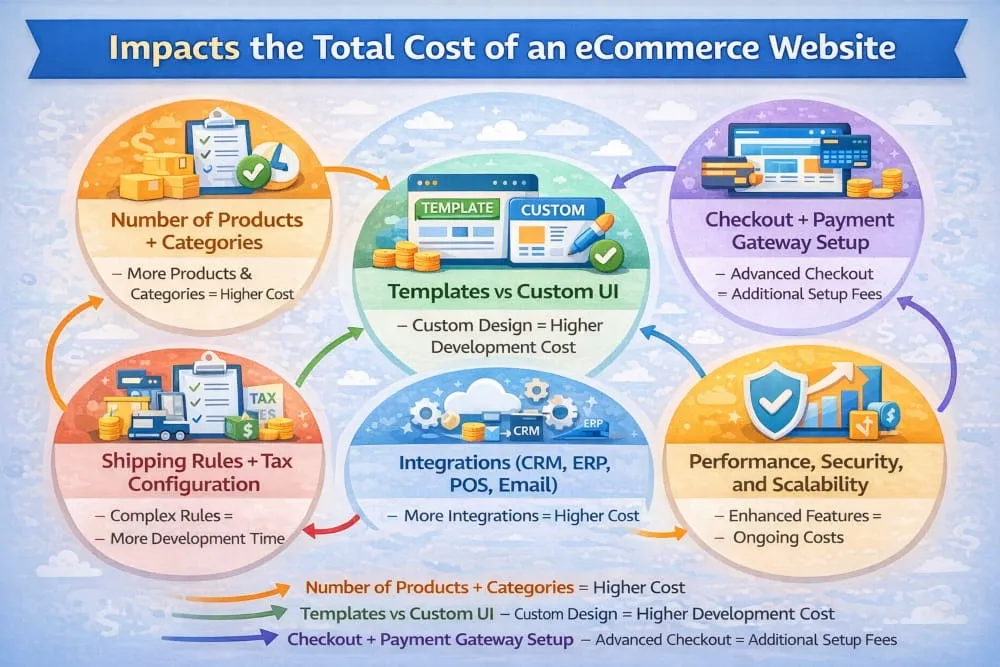
Number of Products + Categories
This is the size of your online catalog, including how many products you sell and how they’re organized into categories and collections.
Adding more products and category levels increases build time because setup, filtering, navigation, and the product data structure become more complex.
Example: A 20-product store with 3 categories is quicker to launch than a 2,000-product store with variations like size, color, and multiple subcategories.
Design Complexity (Templates vs Custom UI)
Design complexity refers to whether your store uses a standard template layout or a fully custom interface built around your brand and customer journey.
A custom design increases the cost of e-commerce website design because it requires more planning, UI work, and detailed implementation across devices.
Example: A template-based homepage is faster to build, while a custom homepage with interactive sections and tailored product displays raises the cost of e-commerce website design.
Checkout + Payment Gateway Setup
This covers how customers pay, including the checkout flow, payment gateway integration, and any additional steps such as coupons, guest checkout, or one-click payments.
The more advanced the checkout setup, the more development and testing it requires, which increases overall costs and can also affect the price of designing an e-commerce website if the checkout experience is customized.
Example: A standard card payment checkout is simpler than a multi-option checkout with Stripe, PayPal, Klarna, and custom cart rules.
Shipping Rules + Tax Configuration
Shipping and tax configuration includes delivery zones, shipping rates, free shipping thresholds, VAT settings, and automated tax rules.
More shipping logic means more setup and testing, which increases build time and can raise costs, especially for stores targeting specific regions, such as the UK.
Example: A single flat shipping rate is simple, while multi-zone shipping with VAT rules can increase both development effort and e-commerce website design costs in the UK.
Integrations (CRM, ERP, POS, Email)
Integrations connect your e-commerce store with tools such as customer relationship management (CRM), enterprise resource planning (ERP), point-of-sale (POS), and email marketing platforms.
Each integration adds cost because it requires configuration, automation setup, and sometimes custom development to sync data correctly.
Example: Connecting your store to a basic email tool is easy, but syncing products, orders, and stock with an ERP system takes significantly more work.
Performance, Security, and Scalability
This refers to how fast, secure, and stable your store is, especially when traffic increases, promotions run, or product pages grow over time.
Higher performance and more substantial security increase costs because they require better infrastructure, optimization, and advanced testing.
Example: A small store with low traffic can run on basic hosting, but a fast-growing store needs performance optimization, stronger security, and a scalable architecture.
Final Note on Design Cost (Budget vs Quality)
If you’re aiming for a low-cost e-commerce website design, you can keep costs down with templates and minimal customization. Still, the tradeoff is usually flexibility and a conversion-focused UX. The best approach is to choose a design level that aligns with your current goals while still supporting future growth, so you don’t have to rebuild your store later.
eCommerce Website Cost Breakdown (What You Pay For)
Understanding where your budget goes makes it much easier to plan a smart build and avoid overspending. This e-commerce website development cost breakdown explains the core components of an e-commerce project, so you know exactly what you’re paying for and why each part matters.
Cost Breakdown Table (Quick View)
Cost Component What’s Included Cost Impact (Low/Med/High)
- Discovery & Planning Requirements, feature list, site structure, project roadmap, Med
- UI/UX Design Wireframes, visual design, mobile-first layouts, design system Med–High
- Development & Build Front-end + backend build, core store setup, functionality High
- Testing + Launch QA testing, bug fixes, speed checks, deployment, go-live support Med
- Post-Launch Support Updates, fixes, improvements, monitoring, ongoing maintenance Low–Med
Discovery & Planning
This is the strategy phase, during which the website structure, key features, and user journey are defined before any design or development begins.
It affects cost because more precise planning reduces rework and ensures the build stays aligned with business goals.
Example: Defining product categories, checkout steps, and must-have integrations upfront prevents expensive changes mid-project.
UI/UX Design
This covers how your e-commerce store looks and how customers move through it, from homepage to product pages to checkout.
It impacts cost based on how custom the design is and how many unique layouts or screens are needed.
Example: A template-based design is faster, while custom page layouts for collections, product pages, and cart experience require more time and budget.
Development & Build
This is where your store is actually built and made functional, including the storefront, backend systems, and all e-commerce features.
It’s often the highest-cost area because it includes the core engineering work that keeps your store running smoothly.
Example: A simple store with standard features costs less than a store with custom functionality, automation, and advanced integrations.
Development Cost (Front-End + Back-End)
Front-end development is what customers see and interact with, while backend development powers the logic behind the scenes (data, processes, and functionality).
Costs increase when the store requires custom components, advanced workflows, or scalable architecture.
Example: A standard product grid is simpler, but a custom storefront with dynamic filtering, personalized sections, and complex checkout logic raises development time.
Product Pages, Filters, Search, and Checkout
These are the conversion-driving parts of your store that directly impact how easily customers find products and complete purchases.
The cost rises as you add more intelligent filtering, faster search, and optimized checkout flows designed to reduce cart abandonment.
Example: A store with basic category browsing is cheaper than a store with advanced filters (size, color, price), predictive search, and a multi-step checkout.
Payment Gateway + Shipping Setup
This includes setting up payment options, configuring shipping rules, and ensuring customers can complete orders without friction.
It affects cost depending on the number of payment methods, shipping zones, and delivery logic your business requires.
Example: One payment gateway and flat-rate shipping is simple, while multiple payment methods plus location-based shipping rates take more setup and testing.
Admin Panel & Inventory Management
This is the backend system you use to efficiently manage products, stock, orders, and customer details.
Costs increase when you need custom admin workflows, automation, or integration with external inventory tools.
Example: A basic admin setup works for small stores, but businesses with extensive catalogs may need bulk product management, stock syncing, and advanced reporting.
Testing + Launch
This ensures your store works correctly across devices, browsers, and real checkout scenarios before going live.
It impacts cost because more features mean more test cases, QA time, and bug fixing before Launch.
Example: Testing a simple store is quick, but testing complex checkout flows, shipping rules, and integrations takes significantly more time.
Post-Launch Support
After Launch, ongoing support keeps your store stable, secure, and continuously improving as your business grows.
It affects cost depending on how frequently you update content, add features, or need technical assistance.
Example: Some businesses only need occasional fixes, while others require monthly improvements, performance monitoring, and continuous optimization.
Hidden eCommerce Website Costs to Plan For (Avoid Budget Surprises)
One of the biggest mistakes businesses make is budgeting only for the build, then getting caught off guard by ongoing expenses after Launch. Planning for these hidden costs upfront helps you protect your investment, keep your store running smoothly, and avoid interruptions that can impact sales.
Here are the most common ongoing costs to expect:
- Hosting: Your e-commerce website hosting costs depend on your platform, traffic levels, speed requirements, and whether you need advanced performance support during peak sales periods.
- Maintenance: Regular updates, security patches, bug fixes, and performance checks all fall under the ecommerce website maintenance cost, and they’re essential for keeping your store stable in the long term.
- Payment fees: Payment gateways often charge processing fees per transaction, which can add up quickly as your order volume grows.
- Plugins and apps: Many stores rely on paid tools for features like reviews, upsells, email automation, subscriptions, and advanced reporting.
- Content and product uploads: Adding products, writing descriptions, uploading images, and keeping categories organized takes time, and may require ongoing support if your catalog changes often.
- Ongoing improvements: Most successful ecommerce stores continuously refine their design, add new features, and optimize conversion rates, so if you’re wondering how much it costs to maintain an ecommerce website, it often depends on how actively you plan to improve and scale your store over time.
By accounting for these costs early, you’ll be able to launch with confidence, and grow without unexpected budget pressure later
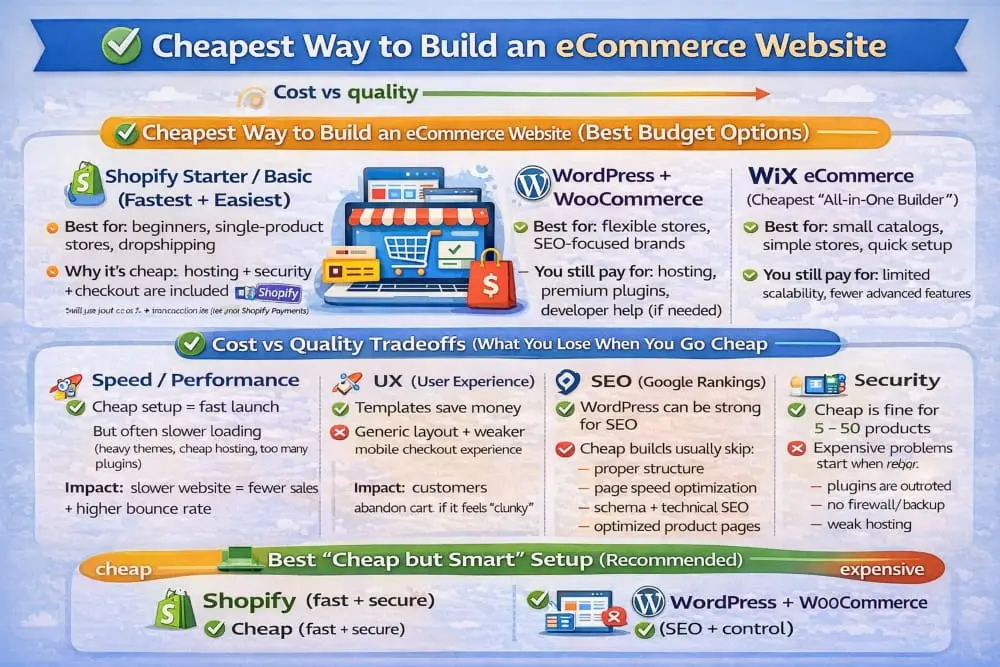
What’s the Cheapest Way to Build an eCommerce Website?
If you’re launching on a tight budget, it’s completely normal to look for the most affordable way to get online fast. The key is to build something that works today, without creating problems that cost more to fix later. The cheapest option isn’t always the best value, but with the right approach, you can start lean and still build a store that’s ready to grow.
When Low Cost Works (and When It Doesn’t)
A low-cost e-commerce website approach can work well when your goal is to validate a product, start selling quickly, or build an MVP with only the essentials. It’s a smart move if you have a small product catalog, simple shipping rules, and you don’t need advanced integrations right away.
However, a low-cost e-commerce website setup can become limiting when your store needs better performance, stronger branding, or features that support growth, such as advanced filtering, automation, or a custom checkout experience. If your business relies heavily on SEO, conversions, or customer experience, cutting too many corners early can slow you down later.
Cost vs Quality Tradeoffs (Speed, UX, SEO, Security)
When you’re trying to keep costs down, it helps to understand what you’re trading off. A cheaper build usually means less time spent on planning, design, and optimization, which affects long-term results.
- Speed: Budget builds may launch quickly, but they can struggle with load time and performance as your product catalog grows.
- UX (User Experience): Basic layouts can work, but they may not guide customers smoothly from product discovery to checkout, reducing conversions.
- SEO: Low-budget setups often skip key structures, such as clean category pages, optimized navigation, and foundational technical SEO, which help you rank.
- Security: E-commerce stores handle customer data and payments, so skipping maintenance, updates, or security best practices can create real risk.
If you want the best low-cost e-commerce website, the most innovative strategy is to start with a solid foundation, simple, clean, and scalable, then add features as revenue grows. That way, you won’t have to rebuild from scratch when your store gains traction.
Get an Accurate eCommerce Website Cost Estimate.
The fastest way to avoid overpaying, or underbuilding, is to get a clear plan based on your exact requirements. A proper e-commerce website cost estimate should reflect what you actually need to launch successfully today, while leaving room to scale as your store grows.
Before requesting a quote, here’s a quick checklist to help you define your project clearly:
Quick Cost Estimate Checklist (Answer These First)
- How many products will you launch with (10, 100, 1,000+)?
- Do you need a custom design, or is a clean template-based layout pleasing?
- What payment methods do you want to offer (cards, PayPal, Klarna, etc.)?
- Will you ship locally only, or do you need multiple shipping zones and rules?
- Do you need integrations like CRM, inventory, POS, or email marketing tools?
- Will you require custom features (subscriptions, bundles, advanced filters)?
- Do you want ongoing support for maintenance, updates, and improvements?
Ready for a Quote?
If you can answer the questions above, you’re already 90% of the way to a realistic budget. Request a quote today and get a tailored cost breakdown based on your business goals, store size, and feature requirements.
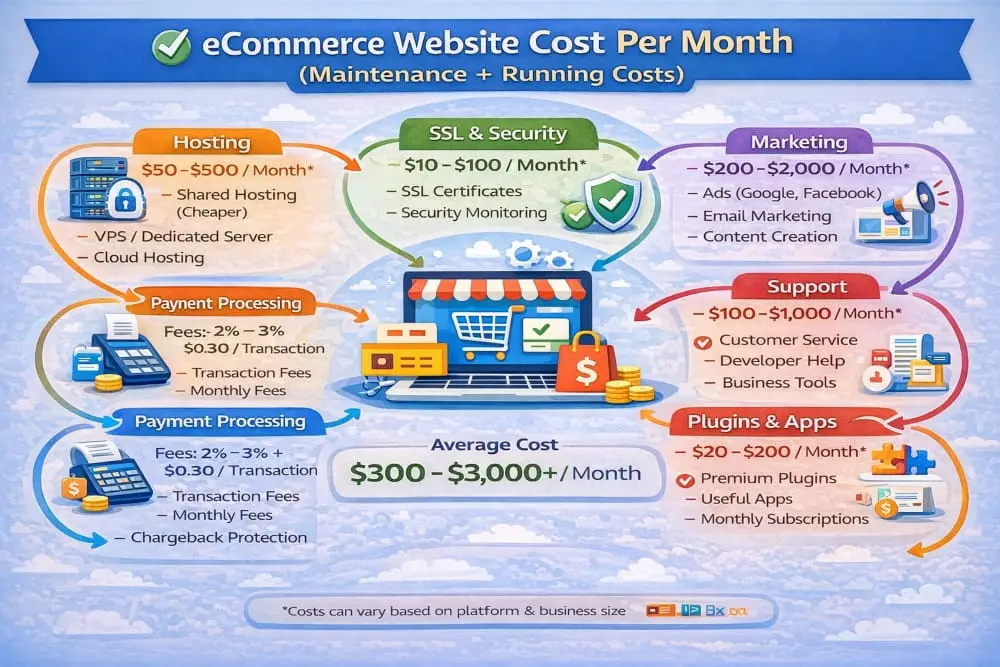
eCommerce Website Cost Per Month (Maintenance + Running Costs)
The upfront build is only part of the investment, your ongoing expenses matter just as much. If you’re planning long-term, understanding the e-commerce website cost per month helps you budget accurately, avoid surprise charges, and keep your store running smoothly after Launch.
So, how much do e-commerce websites cost per month? It depends on your platform, traffic levels, and the level of support you need. Some stores run lean with minimal tools, while others require ongoing development, maintenance, and marketing integrations to stay competitive.
What’s Included in Monthly eCommerce Website Costs?
Your monthly spend usually covers a mix of essential services and optional upgrades. The most common ongoing costs include:
- Hosting and performance management
- Security updates and monitoring
- Bug fixes and technical support
- Platform subscriptions and app/plugin fees
- Content updates (products, banners, pages)
- Backup systems and recovery support
This is why the cost of building an e-commerce website can range from low for small stores to much higher for growing brands with complex needs.
eCommerce Website Maintenance Cost (Ongoing Support)
One of the most significant recurring expenses is e-commerce website maintenance. Maintenance keeps your store secure, stable, and optimized, especially when platforms, plugins, and integrations update frequently.
Typical e-commerce website maintenance costs may include:
- Fixing errors or broken features
- Updating themes, plugins, and extensions
- Monitoring speed and performance
- Security patches and vulnerability checks
- Minor improvements based on user behavior
Without consistent maintenance, even a well-built store can slow down, break down, or lose conversions over time.
Cost of Running an eCommerce Website (Real Monthly Expenses)
The cost of running an e-commerce website isn’t just technical, it includes the tools that help you sell more efficiently. Depending on your setup, your monthly costs may also include:
- Email marketing tools and automation
- Analytics and reporting tools
- Customer support systems (chat, ticketing)
- Inventory and order management tools
- Payment processing fees (varies by provider)
That’s why the cost of running ecommerce website operations can increase as your store scales, even if the site itself stays the same.
Cost of Setting Up an eCommerce Website Per Month (After Launch)
Many business owners assume setup is a one-time cost, but in reality, there’s often a monthly layer that follows Launch. The cost of setting up an e-commerce website per month can include:
- Ongoing improvements and feature upgrades
- SEO and performance adjustments
- New landing pages or seasonal promotions
- Continuous testing for higher conversion rates
This is especially common for businesses actively growing their online sales.
Cost to Build an eCommerce Website Per Month (When Development Continues)
In some cases, the store isn’t finished at Launch, it’s released in phases. If you’re improving your store over time, the cost to build an e-commerce website per month may reflect ongoing development, such as:
- Adding new features (subscriptions, bundles, custom checkout)
- Integrating additional systems (ERP, CRM, shipping tools)
- Improving UX based on customer feedback
- Scaling infrastructure for higher traffic
This approach is often more budget-friendly than paying for everything upfront, while still allowing the store to evolve.
The monthly cost for the e-commerce website depends on the level of support, maintenance, and growth your store requires. A simple store can run with minimal monthly expenses. Still, businesses that want speed, security, and steady improvements should plan for ongoing investment, because your ecommerce website isn’t just a one-time build, it’s a living sales system.
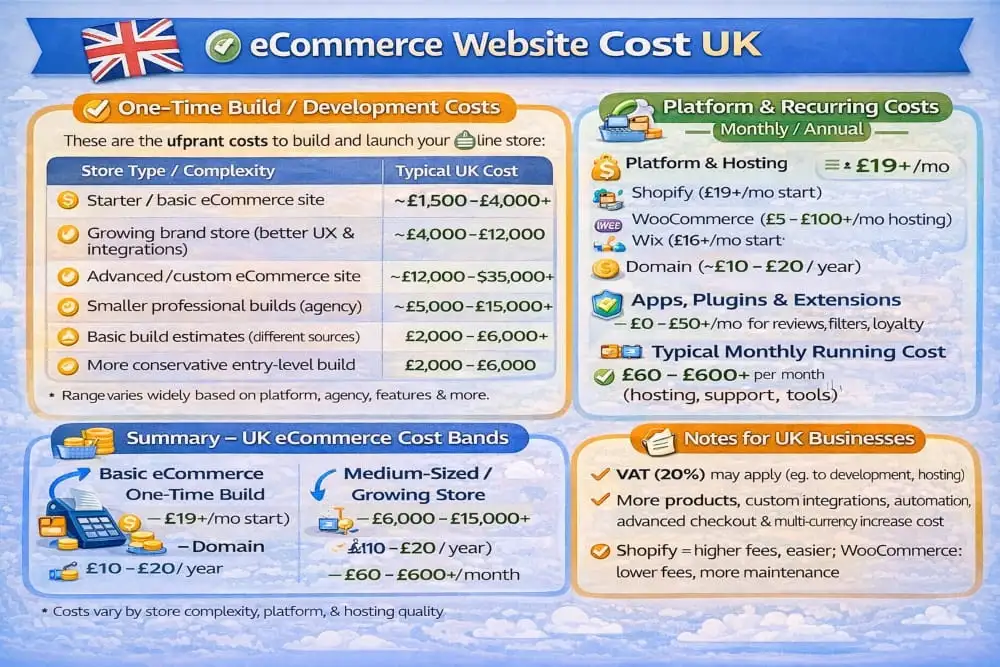
eCommerce Website Cost UK (Pricing Guide for 2026)
If you’re planning to sell online in the UK, it’s essential to understand what you’ll realistically spend, because an e-commerce website in the UK can vary widely depending on your store size, design expectations, and the features you need to operate smoothly.
So, how much does an e-commerce website cost in the UK? For most businesses, pricing typically falls into three ranges: a basic starter store, a mid-range small business ecommerce site, or a fully custom-built design for scale. The final total depends on how complex your store is, how many products you sell, and whether you need advanced functionality such as integrations, custom checkout flows, or automation.
Cost of an eCommerce Website UK (Typical Price Ranges)
The cost of an e-commerce website in the UK usually depends on the level of customization and business requirements:
- Starter ecommerce store: Best for small catalogs and simple checkout needs
- Small business ecommerce website: Ideal for brands that need stronger UX, better design, and key integrations
- Custom e-commerce build: Built for high performance, scalability, and advanced features
This is why you’ll see different quotes even for businesses in the same industry, because one store may be simple, while another requires custom development and deeper system connections.
eCommerce Website Costs UK (What Affects the Total Price?)
When estimating the costs of an e-commerce website in the UK, the most significant cost drivers usually include:
- Number of products and categories
- Custom design vs template setup
- Payment setup (Stripe, PayPal, Klarna, etc.)
- Shipping rules and delivery zones
- VAT configuration and checkout compliance
- Integrations with tools like CRM, inventory, accounting, or email marketing
- Performance and security requirements
The more advanced your store needs to be, the higher the build cost, especially when you want a polished customer experience and a conversion-focused checkout flow.
Best eCommerce Website Cost UK (What Best Value Actually Means)
Many business owners search for the best e-commerce website cost in the UK, but best doesn’t always mean cheapest. The best value usually means:
- A store that loads fast and works flawlessly on mobile
- A checkout process designed to convert
- A scalable build that won’t require rebuilding in 6–12 months
- Clean structure that supports SEO and long-term growth
That’s why the best e-commerce website costs in the UK are often tied to quality, performance, and the ability to grow with your business, not just the lowest upfront quote.
eCommerce Website Cost UK Per Month (Ongoing Running Costs)
Beyond the build, you also need to plan for monthly expenses. The cost in the UK per month depends on your platform, support needs, and store activity.
Typical monthly costs may include:
- Hosting and performance management
- Maintenance and security updates
- Plugin/app subscriptions
- Ongoing improvements and support
So if you’re asking how much an e-commerce website costs in the UK per month, the answer depends on how lean or advanced your setup is. For small stores, monthly costs remain manageable, while growing businesses often invest more to maintain strong performance and conversions.
eCommerce Website Costs UK Per Month (What Businesses Commonly Budget For)
Most businesses plan monthly spending around:
- Store maintenance and bug fixes
- Content updates (products, banners, landing pages)
- Performance monitoring and improvements
- Security checks and backups
- Feature upgrades over time
This is why e-commerce websites in the UK are best viewed as part of a long-term growth strategy, not just an ongoing expense.
The real cost of the UK depends on what you want your store to do today, and what it needs to handle as your business grows. If you want a professional online store that’s fast, secure, and built to convert, the most innovative approach is to invest in the proper structure and features upfront, then budget for ongoing improvements over time.
Conclusion
Understanding the cost of an e-commerce website comes down to one simple truth: there’s no one-size-fits-all price, because every store is built around different goals, features, and growth plans. A basic e-commerce website can be affordable and fast to launch. At the same time, a professionally or custom-built one requires a larger investment to deliver better performance, stronger UX, and long-term scalability.
The most innovative approach is to plan your budget around your business’s current needs, while ensuring your store can evolve as you grow. If you want clarity on pricing, features, and what your build should include, the best next step is to request a tailored estimate, so you can invest confidently and launch with a store that’s built to sell.
Frequently Asked Questions (FAQ’s)
How much does an e-commerce website cost?
An e-commerce website can cost anywhere from a few thousand dollars for a basic store to significantly more for a custom-built, feature-rich site. The final price depends on your design requirements, product volume, and the functionality you need to sell effectively.
What is the average cost of an e-commerce website?
The average cost of an e-commerce website typically falls in the mid-range for most small to growing businesses. Pricing varies based on whether you choose a simple setup or a more professional store with custom UX and integrations.
How much does it cost to build an e-commerce website?
It depends on how complex your store is, how many products you’re selling, and whether you need custom features. A basic e-commerce site costs less, while an advanced build requires more design, development, and testing.
How much does it cost to run an e-commerce website?
Running an e-commerce website involves ongoing expenses, including maintenance, hosting, platform tools, and continuous improvements. Costs increase as your store grows, especially if you add apps, integrations, or monthly development support.
How much does it cost to host an e-commerce website?
Hosting costs depend on the platform you use and the level of performance you need. Smaller stores can run on basic hosting, while high-traffic ecommerce sites often require stronger hosting for speed, security, and reliability.
How much does it cost to maintain an e-commerce website?
Maintenance costs depend on how often your site needs updates, fixes, security monitoring, and feature improvements. Stores with more plugins, integrations, or custom functionality usually require higher ongoing maintenance support.
How much should an e-commerce website cost for a small business?
A small business ecommerce website should cost enough to deliver a professional design, smooth checkout experience, and a foundation that supports growth. The proper budget depends on your product range, required features, and the competitiveness of your market.
Is a custom e-commerce website worth the cost?
A custom e-commerce website is worth it when you need scalability, a unique UX, and advanced features that templates can’t support. It’s often the best choice for growing brands that want better performance, stronger conversions, and long-term flexibility.
How much does it cost per month to run an e-commerce store?
Monthly costs typically include hosting, maintenance, tools, and ongoing improvements. Smaller stores can keep monthly expenses low, while growing ecommerce businesses often invest more to support performance and conversion growth.
What is the cheapest way to build an e-commerce website?
The cheapest way is usually starting with a simple platform setup and minimal custom features. It works best for small catalogs and quick launches, but may require upgrades later as your store scales.


